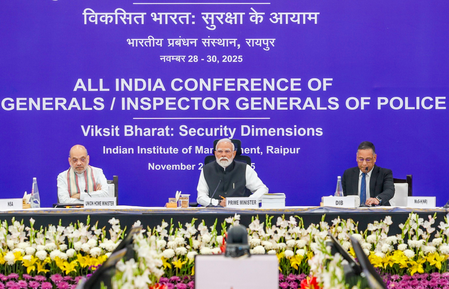
New Delhi, Dec 7 (IANS) Addressing the 60th Annual Conference of DGPs at Raipur on its concluding day on November 30, Prime Minister Modi called upon the Police chiefs from across the country to enhance ‘professionalism, sensitivity and responsiveness’ of their men and stressed on the urgent need to transform public perception of the police, particularly among the youth.
This 3-day conference is traditionally convened and chaired by the Director Intelligence Bureau (DIB), who was acknowledged ex officio as the senior most Police officer of the country, and it provides a rare opportunity to the states to get a comprehensive briefing on the internal security situation of the nation.
The conference used to be held at Vigyan Bhawan in New Delhi earlier, but in the Narendra Modi regime, the practice of organising it in various state Capitals was introduced. Considering that the police were a state subject, this was a good strategic move for promoting the uniformity of law and order management across the country. The DGPs Conference evokes enthusiastic participation from state police chiefs regardless of the differing political complexion of the state governments. This is an acknowledgement of the fact that while law and order was a state subject, national security was the joint responsibility of the Centre and the states.
Projecting a forward-looking role of the Police theme of the conference was ‘Viksit Bharat:Security Dimensions’- the Prime Minister spoke of urban policing, protection of tourists, awareness of the new laws that had replaced the colonial era Penal Codes, coastal policing and monitoring of banned outfits. He emphasised the need to modernise systems for public safety and law and order management. Calling for greater use of technology, he urged the state police to link data bases integrated under NATGRID with use of Artificial Intelligence to produce actionable intelligence on crime and criminals.
He noted that a deeper forensic application would strengthen the criminal justice system and suggested encouraging universities to highlight case studies on the successful use of forensics in the relevant courses. He wanted the state police to contribute more significantly to counter – terrorism and counter-radicalisation effort. The Prime Minister honoured the three best performing cities under the newly instituted Urban Policing Awards, meant to encourage innovation and improvement in policing in urban centres. In recent years, the DGPs Conference has increasingly taken up matters relating to policing apart from reviewing the internal security situation for the benefit of the states.
In advising the Police chiefs to work for transforming public perception of the police, Prime Minister Modi touched on a challenge that Police leadership has still not been able to address adequately. The Prime Minister pithily remarked that police should be sensitive and responsive enough to provide ‘citizen-centric service delivery’.
Police as a coercive arm of the democratic state, can make or mar the content of governance in such a state if it does not help the law-abiding citizens and did not act as a deterrent for the law-breakers. Often, the opposite happened, which explained the reluctance of a lawful citizen to take his complaint to a Police Station.
I recall that during my first posting as ASP- that was decades ago-the District SP who was an officer of great merit, coined the slogan ‘Friendly but not familiar’ for the observance of the annual Police Week. This call holds good even for today’s policing- unfortunately, law breakers often strike ‘familiarity’ with the police while policemen tend to be rather unfriendly towards the ordinary law-abiding people. The onus for correcting all this lies on senior officers of the police. India is perhaps the only country where a police career is offered in one of the All India Civil Services meant to man the Police leadership positions.
The Indian Police Service might face a poser as to what it had done so far to ensure that the functioning of the Police Station had risen to the level of accountability and public service it was supposed to display. Considering that in law, all senior police officers overseeing the police station exercised the powers of the Station House Officers in their jurisdiction, the Police Station emerges as the fundamental unit of policing and the basic point of police-public interface. Public perception about police is linked to how a police station was viewed by the law -abiding people.
The Prime Minister’s expectations of a ‘citizen-centric’ policing would be tested there and hence, police leadership must understand the importance of its role in bringing about the required upgrade of the police station. It is not enough for senior officers to claim flawless working and integrity for themselves- they would be judged by their success in perfecting the functioning of police stations under them. The tradition of senior officers of the rank of even Range Dy IG formally inspecting a Police Station seemed to have been diluted. Surprise visits of senior officers for checking if anybody was there in the lock up without record or the SHO was absent without authorising a sub-inspector to act as in-charge in his absence, would help a great deal in maintaining professional efficiency of the police station.
There are some steps still to be taken for bringing about material police reforms. First of all, ratio of police personnel per lakh of population needs to be improved and the vacancies, said to be as large as 22 percent of the sanctioned strength must be filled up urgently. Law and order management is, in our federal structure, the sole responsibility of the state governments role of the Centre is largely limited to providing para military force on the request of the latter.
To reduce vulnerability of the senior officers to political influences of the parties ruling the states, it is necessary for the Centre to have a say in the appointment of the DGP (and the Chief Secretary) of the state on seniority -cum -merit basis. These are IPS and IAS officers of whose general performance the Centre ( through Deptt of Personnel & Training) kept a track in any case. In line with the 2018 judgement of the Supreme Court that discouraged appointment of ‘Officiating DGPs’ and prescribed the procedure for UPSC-drawn panel of 3 officers being considered for the state DGP’s post, the Centre could play its natural role.
A fixed tenure for DGP had already been laid down by the apex court in Prakash Singh’s case in 2006. Secondly, all Station House Officers should be appointed on the recommendation or with the consent of DGP who should feel strong enough to exercise this authority. And finally, any wrong deed of a police officer should be enquired into taking cognisance of whether or not the supervisory officer like the Circle Officer or even the SP had discharged his function effectively. Fixing the responsibility of the supervisory officer in any case of individual failure is a tradition strictly followed by Army and it is worth emulating that practice on the civil side as well.
(The writer is a former Director Intelligence Bureau)
–IANS
dcpathak/rs