
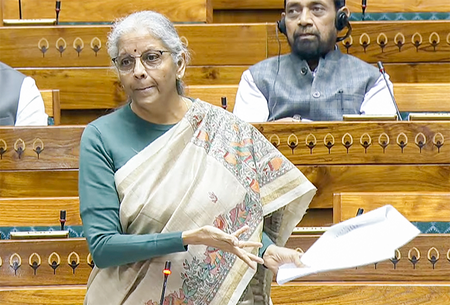
New Delhi, Dec 3 (IANS) India will adopt 2022-23 as the new base year for calculating national accounts with effect from February 26–27 next year, as part of the update to the country’s economic data framework, Finance Minister Nirmala Sitharaman announced in Parliament on Wednesday.
The new 2022-23 base will replace the current base year of 2011–12, which has been in use for over a decade. The update is intended to ensure that national account statistics better reflect the present structure of the economy, she added.
The Finance Minister made the announcement while addressing concerns over the recent C grade assigned to India’s national accounts data by the International Monetary Fund’s Article IV annual assessment of India’s economic framework, released last week. However, she clarified that the IMF rating referred specifically to the outdated base year, not to the quality or credibility of the data.
“The grade was assigned to data on national accounts. What was the reason behind the C rating? That the data is based on an outdated base year, which is 2011-2012, but the Government of India is now changing that, and from next year we will have a data base year as 2022-2023, and from Feb 26-27, it will come into execution,” the Finance Minister said.
The issue was politicised after the National Statistics Office released figures that showed India’s real GDP growth surged by 8.2 per cent during the July-September quarter of 2025-26. Congress’s Rajya Sabha member Jairam Ramesh described the timing of the release as “ironic”, pointing to the IMF’s grading.
However, the IMF’s Article IV annual assessment also states that “India’s strong economic performance has benefitted from sound macroeconomic policies and earlier structural reforms and despite external headwinds, growth is expected to remain resilient, with inflation remaining subdued”.
The IMF’s criticism is focused on the methodology of India’s statistical system, but does not question the authenticity of the data.
“National accounts data are available at adequate frequency and timeliness and provide broadly adequate granularity. However, some methodological weaknesses somewhat hamper surveillance and warrant an overall sectoral rating for the national accounts of C,” it said.
The IMF highlighted an “outdated base year” of 2011-12 on which the data is based.
Senior officials point out that India’s public finance and accounting systems are subject to the scrutiny of the Comptroller and Auditor General, an independent constitutional authority mandated to audit all receipts and expenditure of the Union and the States. CAG reports are tabled in the Parliament and state legislatures and examined by Public Accounts Committees and other standing committees that cut across party lines. This ensures absolute reliability of the data.
Government borrowing is also conducted through the Reserve Bank of India within explicit statutory and rule-based limits. Budget documents, RBI publications, and CAG audit reports cross-validate one another, which reflect the soundness of India’s National Accounts system.
–IANS
sps/vd