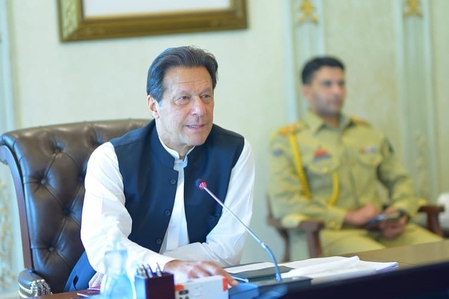
New Delhi, Dec 2 (IANS) Whether by quirk of fate or politics, or that of an incumbent military chief, Pakistan’s Prime Ministers have never been able to complete their term, including the current curious case of Imran Khan.
This was even the fate of the jailed, rumoured dead, ex-Premier’s predecessor, Shahid Khaqan Abbasi, who was arrested on corruption charges in July 2019 during Imran Khan’s government.
Abbasi was accused of awarding a Liquefied Natural Gas (LNG) import contract in 2013 that allegedly caused financial loss to the state. His arrest came amid Imran Khan’s “accountability drive” against opposition leaders, especially from the Pakistan Muslim League-Nawaz.
The action was then largely seen as a highly public, legally contentious, and politically charged move. The administration, however, treated it as part of a crackdown on opposition leaders, framing it with accountability, while critics called it persecution.
By quirk of fate or politics, Pakistan is witnessing a repeat being enacted with a change in characters. Apart from Khan and Abbasi, at least three other former prime ministers have been jailed at various points. They were Zulfikar Ali Bhutto, his daughter Benazir, and also Nawaz Sharif. Charges have ranged from political murder and graft to procurement irregularities and contempt or security-related proceedings. The outcomes varied, including execution, exile, disqualification, or recurrent cycles of release and re-arrest.
The pattern has earned the office of Pakistan’s Prime Minister the moniker of “one of the riskiest jobs in the world”. The current episode’s defining feature is Khan’s reported near-total isolation and denied visits since last month – allegedly despite a court order for weekly access.
Authorities’ denials of death rumours and claims of his health contrast with his family’s insistence that something “irreversible” may be concealed. That has intensified public suspicion and mobilisation, leading Pakistan to declare red alert, sealing roads, banning crowding, concentrating on the capital, Islamabad and the adjoining garrison town of Rawalpindi.
While the former houses the court hearing Imran Khan’s case, the latter hosts the prison where he is presently incarcerated. Rawalpindi’s support has been critical for civilian governments in Islamabad.
Zulfikar Ali Bhutto was arrested following General Zia-ul-Haq’s 1977 coup, Nawaz Sharif was jailed during the 1999 coup led by General Pervez Musharraf, and now, Imran Khan’s incarceration is also being attributed to his rivalry with General Asim Munir.
Incumbent Prime Minister Shehbaz Sharif has been seen to prefer keeping Munir in good humour. But Imran Khan had begun his foray into political power with statements hinting at some control over the army with physical protests against “generals”.
Later, a fallout led to a confrontation with his followers attacking army establishments, even ransacking a general’s residence in the process. The army brass decided to strike back. Imran Khan was then arrested.
Additionally, his personal rivalry with Munir also reflects the country’s ethnic and political tensions. Munir, as army chief, embodies the military establishment’s supremacy. Khan, as a populist politician, challenged that dominance by mobilising mass support, particularly among Pashtuns and the urban middle classes.
The general was removed from his post of Inter Services Intelligence (ISI) chief – an office often seen as more powerful than the army general – in 2019 under Imran Khan’s regime.
The former Premier reportedly tried to block Munir’s rise within the military, while the latter viewed Khan as undermining army authority. Many protestors also allege that Khan’s current travails are a result of the Punjabi-led military’s “oppression of a Pashtun leader”.
Pakistan’s military and bureaucracy have historically been dominated by Punjabis. Pashtuns, represented symbolically by Khan, often feel marginalised.
Amidst the burning embers of discontent and suspicion, the nation – already under economic strains – is revisiting the highly combustible debate on the recurring fate of elected Prime Ministers in the hands of military masters.
–IANS
jb/dan